Minimum Distance Between Toilet Paper Holder, Toilet Bowl, and Vanity Edge
Determining the proper minimum distance between toilet paper holder, toilet bowl, and vanity edge is essential for creating a bathroom that feels both functional and spacious. Many homeowners overlook these measurements until they are already drilling into tile or wood, leading to awkward reaches or cramped quarters. By following industry-standard spacing guidelines, you can ensure that your bathroom layout remains comfortable for every user while maintaining a clean, professional aesthetic.
Understanding these specific clearances will help you avoid common installation mistakes that make a room feel cluttered or difficult to navigate. This information provides the necessary metrics to keep your space compliant with basic design ergonomics.
Recommended Spacing Metrics
The standard rule for the toilet paper holder placement is that the center of the roll should be positioned between 8 and 12 inches in front of the front edge of the toilet bowl. If you place the holder too far back, users must twist their torsos uncomfortably to reach the paper.
If you place it too far forward, it becomes an obstruction or forces a reach that is equally inconvenient. Regarding the height, the center of the roll should sit approximately 26 inches above the finished floor. This elevation is widely accepted as the most comfortable height for the average adult.
When considering the side-to-side clearance, aim for a distance of at least 6 to 10 inches from the side of the toilet bowl to the center of the paper holder. This provides enough room for a hand to move freely without bumping into the porcelain or the vanity cabinet. When you are working in tight corners, these inches matter significantly for overall comfort.
If you are forced to mount the holder on a vanity side panel, ensure the paper does not interfere with the opening of drawers or cabinet doors.
Understanding ADA Requirements for Accessibility 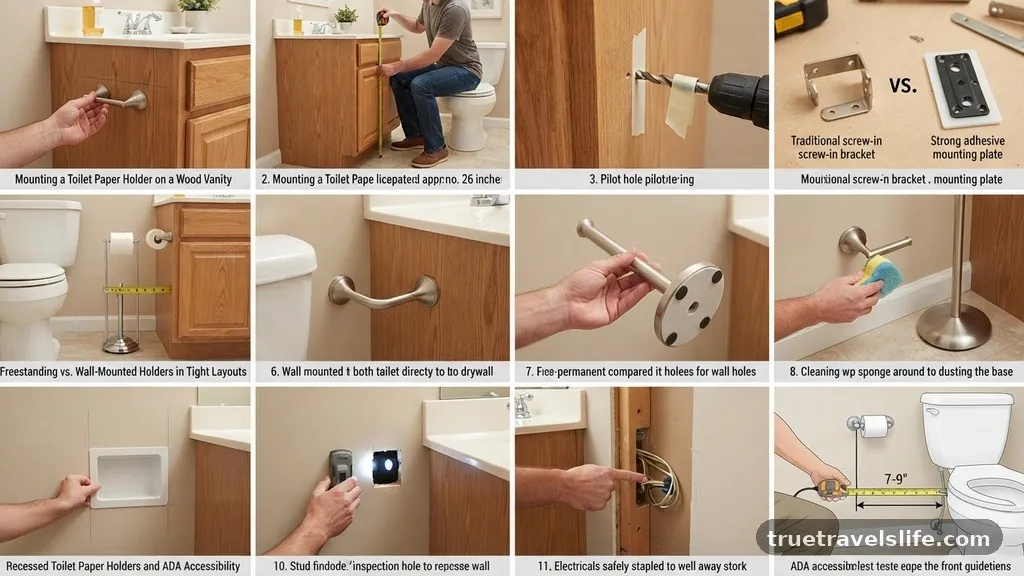
If you are designing a bathroom with universal accessibility in mind, you must look toward the 2010 ADA Standards for Accessible Design. These regulations specify that the toilet paper dispenser must be located at least 15 inches but no more than 48 inches above the finished floor.
The placement in relation to the toilet bowl is also strictly regulated to ensure the roll is not obstructed. Specifically, the dispenser must be positioned within 7 to 9 inches in front of the water closet, measured to the centerline of the dispenser.
These requirements exist to ensure that individuals with limited mobility can reach the paper without straining or losing balance. While residential homes are not always required to meet these exact commercial codes, they serve as an excellent baseline for ergonomic design. Following these standards creates a bathroom that remains functional for guests of all ages and physical abilities.
It is a proactive step toward future-proofing your home.
Measuring Clearance Between Toilet and Vanity
The space between the toilet bowl and the vanity edge is often the most restricted area in a small bathroom. A minimum of 15 inches from the center of the toilet to any side wall or vanity edge is the standard building code requirement.
This ensures that the user has sufficient clearance for their knees and legs. If your vanity is closer than this, you may experience significant discomfort while using the facilities.
If your layout forces the toilet paper holder onto the side of the vanity, you must account for the thickness of the vanity frame. Ensure that the mounting hardware does not penetrate the interior of the cabinet in a way that interferes with plumbing or drawer slides. Always measure from the front edge of the toilet bowl to the vanity side to see if the holder will be reachable.
If the vanity is too far forward, the toilet paper holder might need to be wall-mounted instead.
Strategic Placement for Small Bathrooms 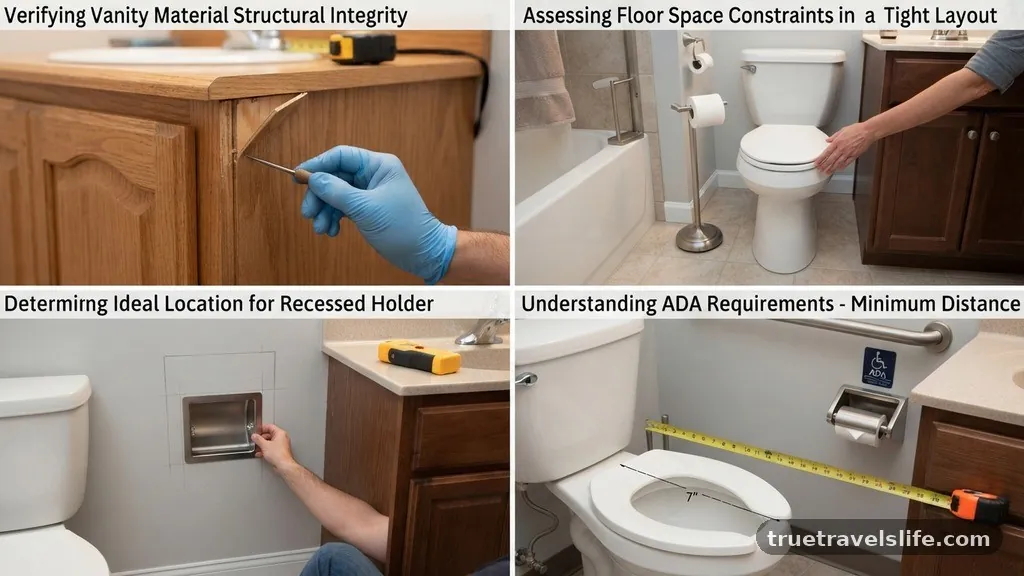
In compact bathrooms, every square inch counts toward the perception of space. If a traditional wall-mounted holder takes up too much room, consider a recessed model that sits flush within the wall cavity.
This eliminates the protrusion of the holder, saving roughly 2 to 3 inches of clearance. This approach is particularly useful when the vanity is positioned immediately next to the toilet.
You might also consider mounting the paper holder on the front of the vanity if the side panel is too cramped. Another popular alternative for tiny bathrooms is a freestanding toilet paper stand. These can be moved as needed, though they do consume floor space.
When choosing a location, prioritize the line of sight and the natural reach of the dominant hand.
Impact of Vanity Style on Holder Location
The style of your vanity often dictates the available mounting surfaces for your paper holder. A floating vanity offers more open floor space, which can make the area around the toilet feel less congested.
If you have a floating unit, mounting the holder on the wall behind it is often the cleanest aesthetic choice. However, a traditional pedestal vanity might offer no side surface area at all.
In cases where you have a large vanity cabinet, you have more flexibility to choose a mounting point that feels natural. Avoid placing the holder directly behind the toilet, as this creates an awkward reach for almost any user. If the vanity is very deep, ensure the holder is not placed so far forward that it hits the user’s knees.
You want to strike a balance between accessibility and keeping the paper away from water spray or splashes.
Comparing Mounting Options
There are several ways to install a toilet paper holder, each with different impacts on the surrounding space. The following table compares common mounting methods based on their space requirements and installation complexity.
| Mounting Type | Space Impact | Ease of Installation |
|---|---|---|
| Wall-Mounted | Minimal footprint | Moderate |
| Recessed | Zero projection | High (requires cutout) |
| Vanity-Mounted | Uses cabinet surface | Low (drilling required) |
| Freestanding | Uses floor space | None |
Each of these options serves a different bathroom layout. Wall-mounted holders are the most standard, while recessed units are superior for high-traffic areas where you want to minimize protruding objects. Vanity-mounted options are perfect for bathrooms where wall space is limited or blocked by mirrors and fixtures.
Choose the method that best complements your specific vanity and wall configuration.
Common Mistakes in Bathroom Layout
One of the most frequent errors is failing to account for the thickness of the toilet paper roll itself. A fresh roll is much wider than an empty cardboard tube and can easily brush against a vanity or wall if the spacing is too tight.
Always test the clearance with a full roll before finalizing your mounting holes. Another common mistake is ignoring the swing of the bathroom door.
Ensure that the toilet paper holder is not placed where it could be struck by the door when it opens. If your bathroom door swings inward and passes near the toilet, a wall-mounted holder could be damaged or prevent the door from opening fully. Additionally, avoid placing the holder near a shower or tub where it might get wet.
Moisture can ruin the paper and lead to unhygienic conditions.
Selecting the Right Hardware
The hardware you choose should match the overall aesthetic of your bathroom fixtures, but functionality must remain the priority. Spring-loaded holders are the most common, but they can be difficult for some users to operate. Pivoting holders are often easier to manage because they lack small, removable parts that can be misplaced.
Consider the material of the holder as well. Brushed nickel, chrome, and matte black are popular finishes that resist corrosion in the humid environment of a bathroom. Ensure that the screws provided with the hardware are long enough to reach the wall studs, or use high-quality wall anchors.
A loose holder is not only annoying but can also damage the wall surface over time.
Factors Influencing User Reach
The physical reach of the users in your home should influence your final placement decisions. If you are designing for a primary bathroom used by adults, the standard 26-inch height is usually perfect.
However, if the bathroom is primarily used by children, you might consider a slightly lower position. Keep in mind that as children grow, a fixed holder might eventually feel too low.
Right-handed versus left-handed users also play a role in comfort. While the right side is the standard for most installations, there is no hard rule forbidding a left-side mount. If the vanity is on the left, it might actually be more ergonomic to mount the holder on that side.
Always simulate the reach before committing to your final drill points.
Maintenance and Cleaning Considerations
Mounting your toilet paper holder in the correct location also makes it easier to clean the bathroom. A holder that is too close to the floor or the toilet bowl base is difficult to mop around.
By keeping the holder at the recommended height and offset from the bowl, you leave clear floor space for a mop or vacuum. This prevents the buildup of dust and grime in hard-to-reach areas.
Furthermore, consider how easy it is to replace the roll. If the holder is tucked into a tight corner or behind a vanity edge, changing the paper becomes a chore. A well-placed holder should be accessible from a seated position without requiring excessive leaning.
Good design should always account for the daily maintenance routines of the users.
Frequently Asked Questions Can I install the holder on the vanity side panel?
Yes, you can install the holder on the side of the vanity, provided there is enough clearance from the toilet bowl. Ensure that the screws do not interfere with the internal structure of the cabinet or any plumbing lines. It is a great way to save wall space in a small room.
What if I have no room for the recommended 15 inches?
If your bathroom is extremely small, you may need to look for alternative solutions like a recessed holder or a freestanding unit.
You can also mount the holder on the front of the vanity cabinet if the side panels are blocked. While 15 inches is the standard for comfort, some smaller powder rooms may require a slight compromise.
Is there a specific rule for the toilet paper roll orientation?
There is no official building code for whether the paper should hang over or under. However, the vast majority of users prefer the “over” orientation for ease of access and tearing.
Choose the orientation that feels most natural to the primary users of the bathroom.
How do I patch the wall if I move the holder?
If you move your holder and need to patch the old holes, use a high-quality spackling compound for drywall. Fill the hole, sand it smooth once dry, and touch it up with paint. If the holder was mounted on a vanity, you may need to use a wood filler that matches the cabinet’s finish.
Does the toilet paper holder count toward ADA compliance?
Yes, the placement of the toilet paper dispenser is a specific requirement within the ADA design standards.
If you are renovating a space intended for public or commercial use, you must follow these guidelines strictly. Residential projects are not legally bound by these rules but benefit from the same ergonomic principles.
Final Thoughts on Bathroom Ergonomics
Achieving the correct minimum distance between toilet paper holder, toilet bowl, and vanity edge is a simple way to improve the daily usability of your home. By adhering to the standard 8 to 12 inches of forward clearance and 26 inches of height, you create a space that feels intuitive rather than restrictive.
These measurements are not just about meeting building codes; they are about respecting the natural movement of the human body. As you plan your next bathroom update, take the time to measure your space carefully before picking up the drill. A little bit of planning goes a long way toward building a more comfortable and functional home environment for years to come.